
Emailing all your customers
Settings then Mass Email sends one message to many customers. You get a limited number of blasts per billing period. The audience dropdown narrows it — everyone, anyone with an upcoming booking, or anyone who visited in the last 30, 90 or 365 days — and the page tells you the recipient count before you write. It does not use your SMS allowance.
Mass Email sends one message to a lot of customers at once — a change of opening hours, a price update, a Christmas closure. Go to Settings and choose Mass Email.
1. Check your allowance
The line at the top tells you how many email blasts you've used this billing period and how many you get. It's a deliberately small number — mass email is for things that genuinely matter to everyone.
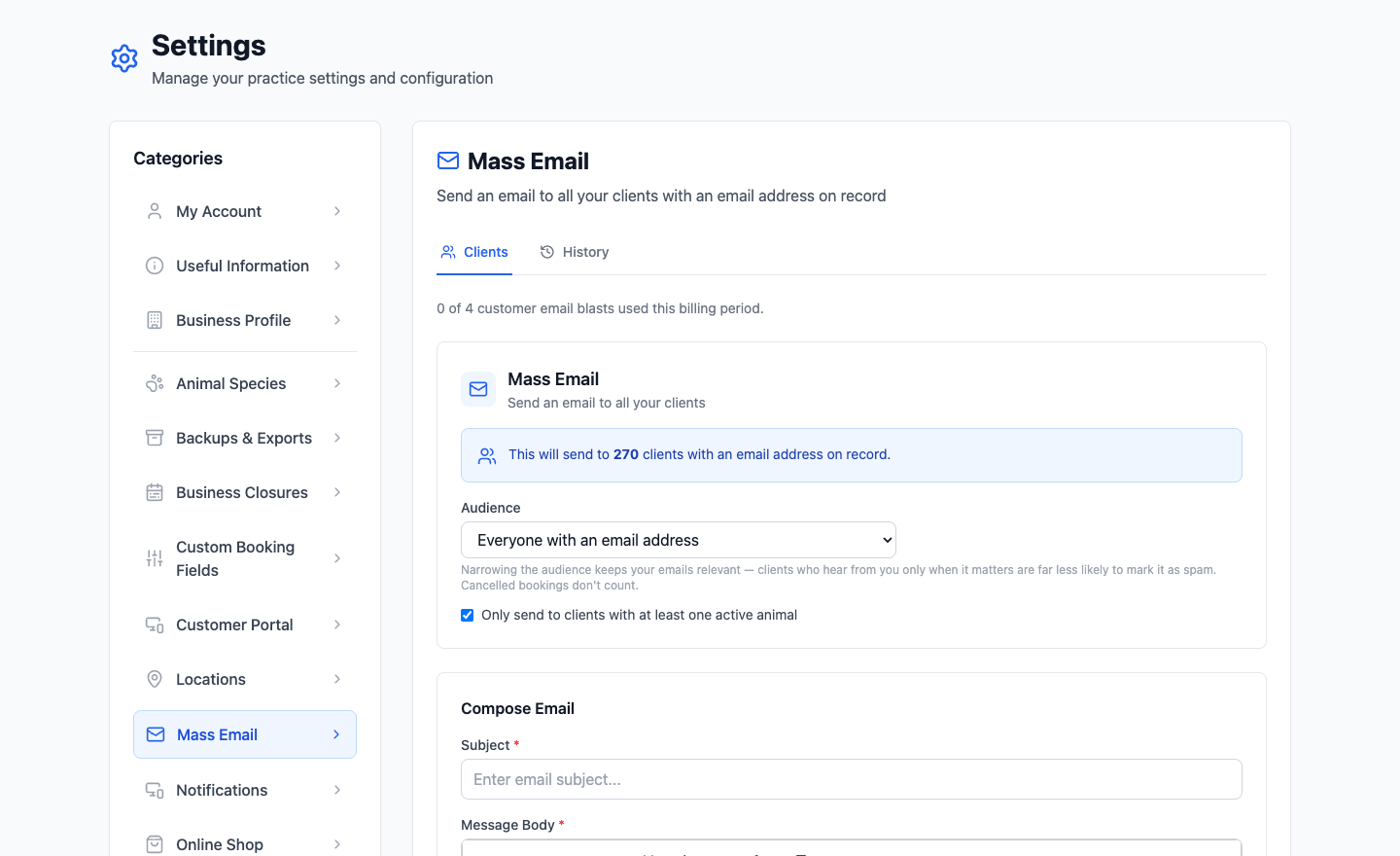
2. Choose who gets it
The Audience dropdown narrows the list, and the blue bar above it updates to tell you exactly how many people that comes to before you write a word:
- Everyone with an email address
- Has any upcoming booking
- Has a booking in the next 7, 14 or 30 days
- Visited in the last 30 days, 90 days or 12 months
There's also a tick box for only sending to customers with at least one active animal, which filters out records that aren't really customers any more.
Narrow it more than feels necessary
Customers who only hear from you when it's relevant are far less likely to mark you as spam — and spam complaints affect whether your emails reach anybody at all. "We're shut next Tuesday" only needs to go to people booked next Tuesday, not to all 300 customers.
3. Write it
Both a subject and a message body are required. Put the actual point in the subject line — "Closed Monday 26th for the bank holiday" gets read; "An update from us" doesn't.
4. Send
Once it's gone, it's gone — there's no recall. Read it once more, particularly the dates. The History tab keeps a record of what you've sent and when, which is the quickest way to check whether a colleague already told everyone.
This is email, not text
Mass Email doesn't touch your SMS allowance, and it only reaches customers who have an email address on record. For something genuinely time-critical, remember that a good number of people read texts and ignore email entirely.